Alright, let’s dive in. I run a basket air fryer supply business, and lately, I’ve been getting so many questions from shop owners and residential buyers about power needs for these little machines. Let’s break this down like we chat at the trade shows or when someone shoots me a DM—no stuffy jargon, just real, usable info. Basket Air Fryer
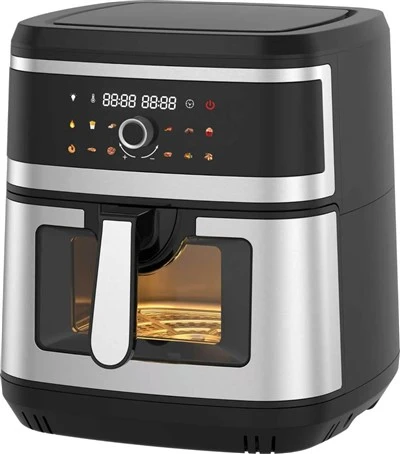
First off, let’s stop with the confusion: basket air fryers aren’t the same as those giant commercial convection ovens you see at restaurants. Their power is way simpler, but get this wrong, and you’ll blow a circuit, or the fryer won’t heat up enough to crisp those fries right. Let’s start with the basics people miss. Most home basket air fryers I supply are between 1,200 watts (W) and 1,800W. Wait, that’s a huge gap—why? Because smaller compact ones (the 1-2 quart sizes perfect for a single person) are 1,200-1,400W, while the family-sized 5-6 quart ones (my bestsellers) hit 1,500-1,800W. Commercial basket air fryers? Those jump to 2,000W+ because they’re running nonstop, cranking out batches for cafes or food trucks. I’ve had a food truck owner come to me last month, he blew his garage circuit running a 1,700W fryer in his truck’s outlet—turns out he needed a dedicated 20-amp circuit for that. That’s a key point I can’t stress enough.
Now, let’s talk about voltage, because that ties directly to power. In North America, almost all residential outlets are 120V, and that’s what 90% of my basket air fryers are wired for. So if you do the math: Power (watts) = Voltage (volts) x Current (amps), right? That’s the formula every electrician swears by. So a 1,500W fryer on 120V is 12.5 amps. Wait, that’s under the standard 15-amp residential circuit—so why did the food truck guy have issues? Because he was plugging it into an outlet that was also powering his microwave and a fridge. Those draw extra amps when they kick on, so total current spiked over 15. Boom, tripped the breaker. So if you’re a home user with a normal kitchen outlet, that 15-amp circuit is fine for one 1,500W fryer, but don’t run other high-watt stuff (microwave, toaster oven) at the same time. For commercial? Let’s say a 2,200W commercial basket air fryer on 120V is 18.3 amps. That’s why commercial users need a 20-amp dedicated circuit—no other devices on it, so no tripping. I had a restaurant owner test this last quarter; he tried plugging two of my 1,800W home fryers into a 15-amp outlet. Each is 15 amps? No, wait 1,800 divided by 120 is 15 amps, so two would be 30 amps—way over, breaker blew instantly. Ended up wiring two separate 15-amp circuits for each, worked like a charm.
Wait, what about people in other countries? Like Europe, they use 220V. So a basket air fryer rated for 220V will draw half the current of a 120V same-watt model. So a 1,500W model on 220V is 6.8 amps—way lighter, perfect for their outlets. But here’s a tip for buyers shopping cross-border: if you’re importing a basket air fryer from the US to use in the EU, make sure it has a dual voltage switch, not just a 120V-only one. I’ve had customers ship back fryers because they fried them plugging into a 220V outlet without a converter. Oops. That’s a common mistake.
Next, let’s get into real-world use cases, because watts aren’t just a number. A lower-watt fryer (1,200W) might take a minute longer to preheat, but for small portions—like a frozen snack for one, or an egg sandwich— it works. But if you’re making a whole batch of crispy chicken wings (8-10 pieces, my go-to test) in a 1,200W fryer? You’ll be waiting 5-7 minutes longer than someone with a 1,800W one. And here’s the thing: my team tests every basket air fryer before we stock ’em, and even if a model is rated 1,600W, some might actually draw a bit more when running at max heat. We add a 10% buffer when telling customers about power needs—so if a fryer is rated 1,700W, suggest a circuit that can handle up to 18.7 amps, so no surprises.
What about extension cords? People grab any old extension cord, but that’s a big power drain. If you use a cheap, thin 16-gauge cord for a 1,800W fryer, the cord itself will lose power—meaning your fryer might only get 1,000W, so it won’t crisp. I always tell buyers to use a 14-gauge extension cord at max, and keep it under 6 feet long. Longer cords mean more resistance, so less power gets to the basket air fryer. A guy from a pop-up shop came to me once, he had a 25-foot 18-gauge cord, his fryer barely heated, he thought the fryer was broken. We swapped the cord, and it worked like new. That’s a simple fix no one tells you.
Now, let’s clear up a myth I hear all the time: “Higher wattage means better air fryer.” Nah, not at all. A 1,800W model from a cheap brand might have bad heating elements that are uneven, so your fries will be burnt on the edges and raw in the middle. My basket air fryers are all 1,500-1,800W, but we use precision heating elements, so even the lower-watt ones heat evenly and fast. The power just needs to match the setup, not the brand hype. So a single apartment dweller doesn’t need a 2,000W model—they’ll just blow their circuit for no reason.
For commercial buyers, this is non-negotiable. Let’s say you’re a food truck turning out 5 batches of fries an hour. A 2,200W commercial basket air fryer on a dedicated 20-amp circuit will handle that without stopping. If you use a residential 1,800W model, it’ll overheat after 3 batches and throw an error. I work with a lot of small cafes, and we always recommend sizing the power to their peak use: if they do 20 orders a day, a 1,800W commercial model on a 20-amp circuit works. If they do 100+ a day, two of those, so they can run one while the other cools. No downtime, no lost sales.
Wait, also about surge protectors. Can you plug a basket air fryer into a surge protector? I’d be careful. Most surge protectors are rated for 15 amps, which is fine for home use, but some cheap ones can’t handle the inrush current when the fryer turns on. The inrush current is the extra juice it needs to heat up fast—usually 10-20% more than the running current. So a 1,500W fryer (12.5 amps running) might pull 14-15 amps when it kicks on. A bad surge protector can’t handle that, so it trips immediately. I tell home users to plug their basket air fryer directly into the wall if they can, but if they must use a surge protector, get one rated for at least 15 amps, and look for “heavy duty” on the label. No power strips—those are even worse, they’re not designed for high-watt appliances.
Let’s wrap this up with what I’ve learned from being a basket air fryer supplier for 5 years. The key is: match the power and circuit to your use, not the size of the fryer. For home users: 1,200-1,800W on a 120V 15-amp non-dedicated circuit, no other high-watt devices running at the same time. Use a thick, short extension cord, skip the power strips. For small commercial (cafes, food trucks): 1,800-2,200W on a dedicated 20-amp circuit. For big commercial: multiple 2,000W models on separate circuits. And never skimp on the cord, that’s the #1 avoidable issue.
If you’re looking for basket air fryers to stock your shop, or just need help figuring out the right power setup for your space, hit me up to chat. I’m not here to push the most expensive model— I’ll give you the straight scoop, whether you need a 1,200W single-serve one or a 2,200W commercial workhorse.
Air Fryer Oven References
- International Electrotechnical Commission. (2021). Safety of household and similar electrical appliances – Part 2-2: Particular requirements for cooking appliances and frying pans.
- US Department of Energy. (2022). Appliance Basics: Understanding Wattage and Electrical Requirements for Kitchen Appliances.
- National Fire Protection Association. (2023). Electrical Safety in Commercial Food Service Facilities.
- Consumer Reports. (2022). Air Fryer Buying Guide: Power Needs and Setup Tips for Home Use.
Guangdong Qiaokang Electrical Appliances Co., Ltd.
As one of the most professional basket air fryer manufacturers and suppliers in China, we have world-leading production equipment and strong manufacturing capabilities. Please rest assured to buy advanced basket air fryer made in China here from our factory. Customized orders are welcome.
Address: No. 18, Jinxiang Road, Sanjiao Town, Zhongshan City, Guangdong Province
E-mail: sales01@gdboling.com
WebSite: https://www.qiaokanghome.com/
